Storm hit?24/7 emergency tarp & free inspection — Mon–Sat · 7a–8p(919) 892-0034

INSURANCE CLAIMS
We're a NC roofing company first. Most of our work is plain roofing — replacements, repairs, gutters, siding. But when a storm hits and the claim goes sideways, this is the part of the job we're built for. Denied, underpaid, adjuster missed half the damage — you are not imagining it, and you are not the first.
Bring us the letter. We'll tell you honestly whether the claim is worth fighting — and if it is, we'll fight it with you. Free inspection, free claim review, no pressure. This is, frankly, the claim other roofers wouldn't touch.
WHY CLAIMS GET DENIED
Most denials are not about whether your roof is damaged. They are about how the damage was documented, classified, or timed. Here are the five we see most often in NC.
The single biggest reason. The adjuster spent twenty minutes on your roof, took a dozen phone photos, and called it. If your file does not have close-ups of every slope, vent boot, flashing detail, and ridge cap — with measurements and dates — the carrier can argue the damage is not what you say it is. Documentation is the case file. Thin file, thin claim.
NC policies expect notice of loss promptly after a storm. Wait six months and the carrier will ask why — and start looking for ways to argue the damage is wear-and-tear, not storm. The longer the gap between the storm date and the claim date, the harder the file is to defend, no matter how real the damage.
NC building code changes. If your roof needs ice-and-water shield, drip edge, or upgraded decking to be brought to current code — and the original estimate did not include those line items — the carrier will pay only for the old scope. A proper estimate names every code-upgrade requirement and quotes it. A lazy estimate skips them and you eat the cost.
Hail bruises and wind-creased shingles can look, to an untrained eye, like normal aging. If the adjuster writes "mechanical damage" or "granule loss due to age," the carrier denies the claim — even when the damage is plainly storm-related. This is the most common reversible denial. We re-shoot the evidence and write the rebuttal.
Your contractor wrote a $22,000 scope. The carrier's estimate came back at $9,800. That gap usually means missed line items — flashings, pipe boots, ridge vents, dump fees, code upgrades — or an outdated price list. A supplement (a formal, line-itemed request for additional payment) closes the gap. This is most of what we file.
WHAT IS A SUPPLEMENT?
A supplement is a written, line-itemed request to your insurance company for additional payment on items the original estimate missed or under-priced. It is the tool we use most. It is also the tool most homeowners do not know exists.
You file a supplement when the adjuster's estimate does not match what the roof actually needs. Common scenarios:
The estimate is missing line items
Drip edge, ice-and-water shield, ridge vents, pipe boots, step flashing — small items that add up to thousands. We compare your estimate against the actual roof and itemize what was missed.
Code upgrades were not included
Your home was built to a code that has since changed. NC requires modern roofs to meet current code on replacement. If the estimate uses the old standard, the carrier owes the difference.
The price list is out of date
Insurance pricing software updates quarterly. If the adjuster wrote your estimate six months ago, materials and labor have moved. We rerun the numbers at current rates.
New damage was found during tear-off
You cannot see rotted decking from the outside. Once the old shingles come off, anything we find that was not in the scope becomes a supplement. This one happens often.
Matching is required and was denied
NC policies often require matching of materials when only part of a slope is damaged. If the carrier authorized a partial replacement and the shingles do not match, the supplement asks for full replacement of the affected sides.
Supplements are routine — they are how the system is designed to work. The only unusual part is having a contractor who actually files them.
FREE DOWNLOAD
Supplement request template — fillable letter format and 10-item table, ready to send to your adjuster.
INTERIOR DAMAGE
When a roof claim is approved, the interior damage often gets included as part of the same claim scope — water stains on ceilings, sagging drywall, damaged insulation, and leaking interior trim. The roof and the interior are one event. One insurance check should cover both.
Without a contractor who handles both sides, you get stuck coordinating two separate trades, two separate schedules, and often two separate claims — even though all the damage traces back to the same storm. A1 handles the roof and the interior repair.
We document interior damage as part of every inspection. If the scope includes water staining, drywall, or insulation replacement, we write it into the same supplement letter — so you don't have to manage two contractors or fight two claims.
Water stains on ceilings
Visible staining is evidence — photographed, documented, and included in the scope. Don't paint over it before we see it.
Sagging or damaged drywall
Water-soaked drywall can't be dried and reused. When replacement is required, we include it in the claim scope.
Compromised insulation
Wet insulation loses R-value and grows mold. It's a code item on a full replacement — the carrier owes it when the damage is covered.
Interior trim and finish work
Window trim, door casings, and interior moldings damaged by leak water are part of the same event. We scope it all.
RCV vs ACV
Most denied or underpaid claims trace back to two letters most homeowners have never had explained to them: RCV and ACV. Here is the whole thing in plain English.
RCV
Replacement Cost Value
What it actually costs, today, in current materials and labor, to replace your roof. This is the number you want. If you have an RCV policy, this is what the carrier ultimately owes — though they pay it out in two pieces.
ACV
Actual Cash Value
What your roof is worth today, after subtracting depreciation — the reduction the carrier applies for age and wear. ACV is always less than RCV. This is the first check.
WORKED EXAMPLE
First check: $13,000 (ACV minus deductible)
The carrier sends this when the claim is approved. It is yours to start the work. The depreciation amount is held back.
Second check: $4,000 (recoverable depreciation)
Once the work is complete and the carrier sees the final invoice for the full RCV amount, they release the held-back depreciation. You have to do the work and submit proof to get this. If the work is never done, this money never comes.
Heads up: if you have an ACV-only policy, the second check never comes — you get the $13,000 and that is it. Check the declarations page (the front-page summary of your policy) to see which kind you have. RCV is what you want; ACV-only is what cheaper policies use to keep premiums down.
FREE DOWNLOAD
Get the RCV vs ACV explainer as a printable PDF — comparison table, worked example, and a dec page reading guide.
OUR PROCESS, IN DETAIL
Plenty of roofers will sign a contract the day after a storm and let your insurance company write the scope. We do this differently. Five steps — every time, every roof.
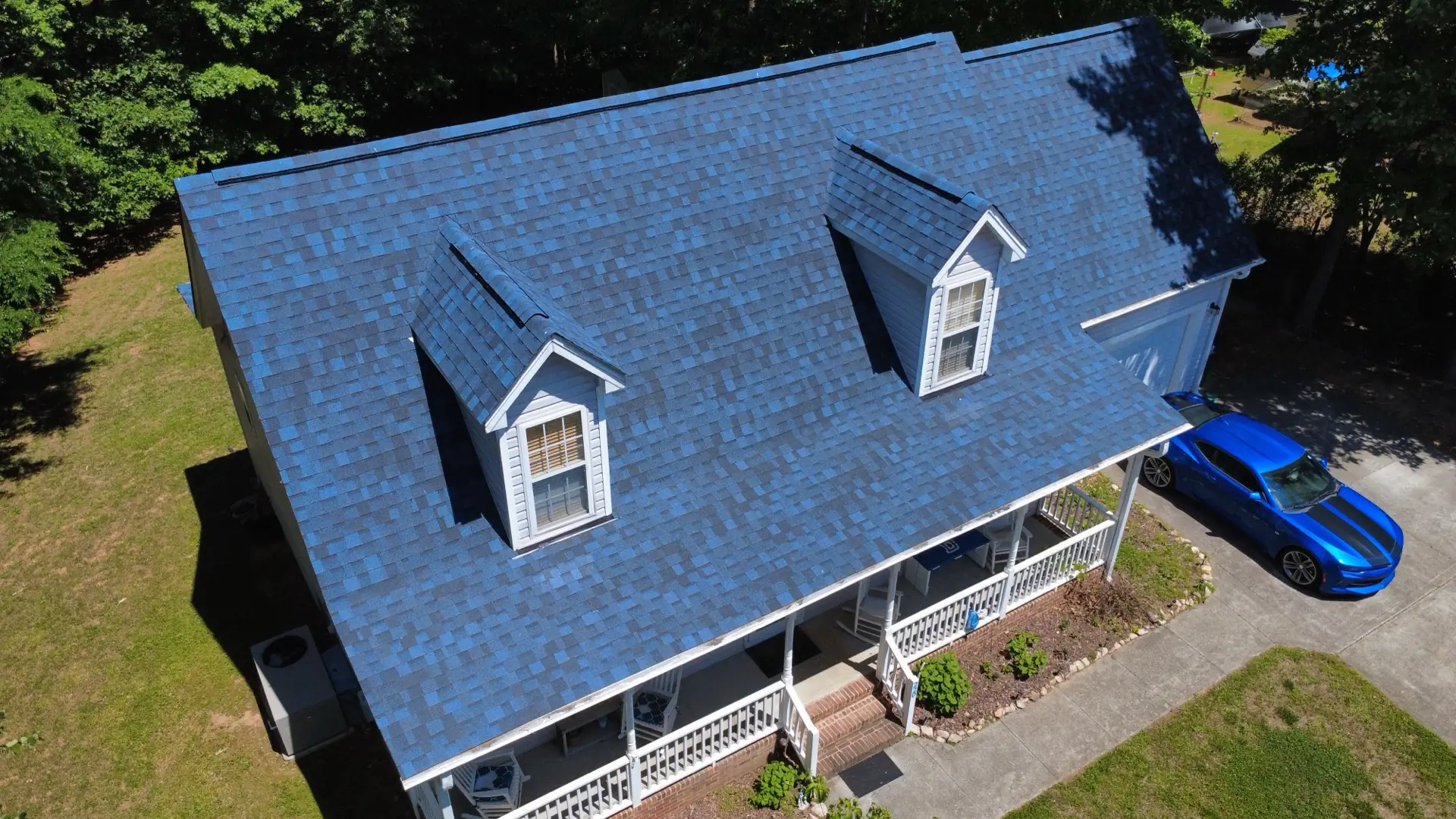
Two camera passes — drone overhead at low altitude for slope-by-slope coverage, and a ground photographer for the close-up evidence: hail bruises with rulers in the frame, lifted shingles, granule pockets in the gutters, dented gutter aprons. Every photo is timestamped and geotagged. The carrier cannot argue with photos taken from a meter away.
Hail-bruised shingles often look fine on top while the mat underneath is fractured — that is where leaks start six months later. We pull cores in suspect zones and use a moisture meter on the decking. If we find moisture, that is a code-required tear-off conversation with the carrier, not a debate.
Most contractors send the carrier their estimate and hope. We send a supplement letter — a formatted, line-by-line argument that names every missed item, cites the price-list code, attaches the photo evidence, and references the policy language. Adjusters read this kind of letter. They cannot read a hope.
Re-inspections that happen on the phone go nowhere. Re-inspections where we are physically on the roof with the adjuster — pointing at the bruise, showing the tape measure, lifting the shingle — almost always move the number. We schedule it, we climb it, we walk them through it. If you have one shot at reversing a denial, this is it.
NC code requires drip edge, ice-and-water shield in valleys, modern decking thickness in some spans, and ventilation that older roofs never had. We pull the relevant code section, name it in the supplement, and itemize the upgrade cost. Carriers owe code upgrades on a covered loss. They will not pay them unless someone asks in the right language.
WHAT TO BRING
You do not need to be organized. You do not need to have read the policy. You just need to find these four things — even if they are in a kitchen drawer, an email folder, or a phone camera roll. We'll do the reading.
If you cannot find one of these, come anyway. We can usually pull missing pieces directly from the carrier with your authorization.
The denial letter or claim adjustment letter
The piece of mail or PDF that says either "your claim has been denied" or itemizes what they paid. The reasoning in this letter tells us exactly what to rebut.
Your declarations page
The two-to-three-page summary at the front of your policy. It lists your dwelling coverage, deductible, wind/hail deductible, and whether you have RCV or ACV coverage. Every claim conversation starts here.
Photos you have already taken
Anything you shot from the ground after the storm — hail in the yard, dented gutters, shingle pieces on the lawn. Even phone snapshots help establish the timeline. Bad photos are better than no photos.
Contact info for your adjuster
Name, phone, email, and the claim number. If you have it, bring the original scope of work the carrier sent. If you do not have any of this, that is fine — we can request it.
REAL TALK
Your insurance company already said no. We've heard that one before. The system is built so that the path of least resistance for the adjuster is to underpay or deny. That is not malice — it is incentives. Most claims that get reversed get reversed because somebody pushed.
We are that somebody. Not for a percentage. Not for a fee on top. For the cost of the work, paid out of the check the carrier already owes you.
QUESTIONS WE GET
Want to see how we've handled claims like yours from start to finish?
See completed jobs →FREE CLAIM REVIEW
Free inspection. Free claim review. We'll tell you honestly whether it's worth fighting — and if it is, we'll fight it with you.
FREE INSPECTION
Thirty-minute inspection. Written report. Photos of every slope. No charge whether or not you file a claim.
Or just call us directly:
(919) 892-0034